The next phase of AI is not about making every employee more productive. It is about redesigning the organization itself.
Today at 8vance, we had a discussion that started with software development and ended somewhere much bigger.
AI is generating an increasing share of our code. That changes the role of developers. Less time is spent writing every line themselves, more time is spent directing, validating and reviewing what AI produces.
So far, so familiar.
But then someone asked the obvious next question: if AI writes the code, why should humans review all of it?
What if another AI can review the code? What if a third system tests it, checks security vulnerabilities and compares the result against the architecture and requirements? What if AI can find errors in AI-generated work more consistently than a human reviewer who is trying to keep up with an ever-growing volume of generated code?
This is not science fiction anymore. GitHub reported earlier this year that Copilot had already performed more than 60 million code reviews and accounted for more than one in five code reviews on GitHub.
Our conversation therefore quickly stopped being about code.
It became an organization design question.
If AI can execute work, coordinate work and increasingly review work, what exactly should humans still be organized to do?
I have been fascinated by how we organize talent and work for years. How do we move away from rigid jobs and departments towards the actual work that needs to be done? How do we organize around tasks, problems, capabilities and people rather than boxes in an org chart?
With AI, that search suddenly feels more relevant than ever.
We are putting AI into organizations designed for a world without AI
Dorsey and Botha (Block) recently published a fascinating essay called From Hierarchy to Intelligence. Their argument starts with a simple observation: hierarchy is not some natural law of organizations. It developed as a solution to an information problem.
For centuries, large organizations needed layers of people to collect information, make sense of it, coordinate others and pass decisions up and down. The Roman army did it. Railroads did it. Modern corporations inherited it.
Block is now challenging the underlying assumption that humans need to remain the coordination mechanism. Their ambition is not simply to give everyone an AI copilot. They are experimenting with something closer to a company operating as an intelligence, with a continuously updated model of the business providing context that previously travelled through management layers.
That is a much more radical idea than productivity.
Most organizations are currently doing something else. They take the existing structure and add AI to it.
The recruiter gets AI. The developer gets AI. The consultant gets AI. The manager gets AI. Everyone becomes faster, while the org chart remains almost untouched.
That can create significant value. But it may also mean we are optimizing a structure whose assumptions are becoming obsolete.
If AI had existed when your company was founded, would you really have designed the same jobs, departments, reporting lines and management layers?
I doubt it.
My hypothesis: AI will unbundle three things
I don’t think the future can be summarized as “AI will flatten organizations.”
That is too simple.
My hypothesis is that AI is starting to unbundle three things that our current organizations bundled together: execution, coordination and control.
And once those three come apart, the traditional job and the traditional hierarchy both become unstable.

First, execution becomes unbundled from the job
A job is not a natural unit of work. It is a collection of activities we happened to bundle together.
Take a software developer. The job might include analyzing a problem, designing a solution, writing code, debugging, testing, documenting, reviewing colleagues’ work, discussing architecture and coordinating releases.
AI does not “replace the developer” in one movement. It enters this bundle task by task.
First it assists with code. Then it generates code. Then it debugs. Then it creates tests. Then it reviews pull requests. Then it implements the changes suggested by the review.
GitHub already allows Copilot to review a pull request and subsequently hand the feedback back to a Copilot coding agent to implement the changes. The boundary between creating and checking the work is already becoming blurry. (Easily apply Copilot code review feedback with Copilot cloud agent, 2026.)
So asking “Will AI replace developers?” misses what is actually happening.
The better question is: which parts of software development still belong together as one human job?
And exactly the same question applies to recruitment, finance, HR, marketing, consulting and management.
Then coordination becomes unbundled from management
This is where the Block argument gets interesting.
A large part of management is coordination. Gathering information, interpreting it, setting priorities, tracking progress, resolving dependencies and ensuring that people have enough context to act.
AI is becoming very good at parts of that work.
McKinsey calls the emerging model the “agentic organization“, where humans increasingly work with fleets of agents and may move from being in the loop to being above the loop. It even describes small human teams supervising dozens of specialized AI agents. At the same time, McKinsey is more cautious than some of the headlines suggest. Alexis Krivkovich explicitly says it is still too early to know the final shape of the organization and that fluid pods are much harder to implement than the diagrams suggest. (McKinsey, AI is everywhere. The agentic organization isn’t yet, 2026.)
That nuance matters.
Because coordination does not disappear when you remove managers.
Someone, or something, still has to decide what matters, resolve conflicts, distribute resources, develop people and connect strategy to daily work.
Toby Culshaw made exactly this counterargument in a recent critique of the “Great Flattening”. Their point is that many flattening models simply remove boxes from an org chart without accounting for where the work performed by those boxes goes. Sometimes the manager disappears, but management does not. It simply gets redistributed to team leads, individual contributors or AI-agent owners. (Talent Intelligence Collective, McKinsey is wrong. The Great Flattening Is Mostly a Relabelling Exercise, 2026.)
I think that critique is right.
But it does not invalidate the AI-native organization.
It makes the design challenge more interesting.
Management may not disappear. Management may become a property of the system rather than a position in the hierarchy.
That, to me, is a much bigger shift than flattening.
Finally, control becomes unbundled from human review
This brings me back to our conversation at 8vance.
We often respond to AI autonomy with the phrase “human in the loop”.
It sounds reassuring. AI does something, a person checks it, and therefore we remain safe and responsible.
But human review is not infinitely scalable.
Imagine an AI coding system producing ten times as much code. If every line ultimately needs the same amount of human review, AI has simply moved the bottleneck downstream.
We could hire more reviewers, of course.
But there would be something strange about building a new layer of human bureaucracy to check the output of technology we introduced to remove human bottlenecks.
IBM recently made a similar point from a governance perspective: “human in the loop” by itself is not a governance strategy. Meaningful oversight depends on whether the human can actually understand what they are reviewing, has the authority and context to intervene, and is doing more than rubber-stamping machine output. (IBM, Why “human in the loop” alone is not a governance strategy, 2026.)
That means we need a more sophisticated question than “Where do we keep a human in the loop?”
We should ask:
Where does human judgment genuinely improve the loop?
Sometimes the answer will clearly be yes. Ethical decisions. Novel situations. Conflicting values. Human relationships. High-impact exceptions. Moments where context, trust and responsibility matter.
But there may also be processes where AI produces something, another AI validates it, automated testing verifies the result and humans only monitor exceptions and outcomes.
Human in the loop becomes human on the loop.
And sometimes perhaps human accountable for the loop.
That is uncomfortable territory, because it forces us to separate human dignity and responsibility from the idea that a human must manually touch every piece of work.
The org chart is starting to miss half the organization
There is another consequence that I think deserves much more attention.
If one employee operates five AI agents, and those agents interact with agents owned by other people, what exactly is the organizational unit?
Ten humans?
Ten humans and fifty agents?
Who manages the agents? Who gives them access? Who evaluates them? Who retires them? Who notices when their behavior changes? Who decides which agent may talk to which other agent?
The Talent Intelligence Collective rightly points out that most future-of-work diagrams simply don’t draw this second workforce. The humans are visible. The agents are not. Yet the coordination, governance and quality-control load around those agents is real.
This suggests that the org chart itself may become the wrong representation of an organization.
Perhaps we need something closer to a work graph: humans, agents, capabilities, decisions, tasks, data, responsibilities and outcomes connected dynamically.
That would fundamentally change workforce planning.
Counting employees would tell us less and less about organizational capacity.
The more relevant questions become: What outcomes can this human-AI system produce? Where does decision-making slow down? Which capabilities are scarce? Where is human attention essential? Where are agents duplicating work? Where does accountability sit?
That is where HR, workforce planning and talent intelligence become central to AI transformation rather than peripheral to it.
Don’t flatten the organization. Redesign the work.
This is also where I think some organizations risk taking a shortcut.
Removing management layers is visible. Headcount reductions show up immediately. Redesigning work, information flows, decision rights and human-AI interaction is much harder.
And there are already warnings about treating AI-native organization design primarily as a headcount exercise. Recent experiments show that aggressively reducing human capacity before the new operating model actually works can create new coordination problems rather than solve old ones.
So I would not start with the question:
How many people can AI replace?
Nor would I start with:
How many management layers can we remove?
I would start much lower down:
What work needs to happen? Who or what is best positioned to do it? Who or what should check it? Where is human judgment essential? And how do all those parts coordinate without recreating the bureaucracy we were trying to remove?
Only after answering those questions should we draw the boxes.

From a hierarchy of people to an architecture of intelligence
This, I think, is the real organizational challenge of the next few years.
The industrial organization bundled tasks into jobs, jobs into departments and departments into hierarchies.
The AI-native organization may look fundamentally different.
Tasks can move between humans and agents. Agents can coordinate other agents. Teams can form around outcomes rather than functions. Human expertise can be deployed where judgment, relationships, creativity and responsibility matter most. Coordination increasingly happens through shared intelligence rather than endless information routing.
But that does not mean leadership disappears. It does not mean people disappear. And it definitely does not mean we can delete half the org chart and assume AI will magically absorb everything that was happening there.
It means we have to become much more precise about what humans are actually for.
And perhaps that is the uncomfortable gift AI is giving us.
For decades, we designed people around the organization.
Now we have an opportunity to redesign the organization around the work, the technology and the humans we actually have.
So the question we ended up with today at 8vance is one I think every leadership team should discuss:
If AI can do the work, coordinate parts of the work and increasingly review its own work, how would you organize your company if you were starting again today?
Not in five years.
Today.
I don’t think anyone has the definitive answer yet.
Block doesn’t. McKinsey doesn’t. We don’t.
And that is precisely why this is such an interesting moment.
The next phase of AI transformation is not putting AI into the organization we already have.
It is discovering what kind of organization becomes possible because AI exists.
Let’s continue the conversation
I will be exploring different parts of this question in several upcoming sessions and keynotes. If you are attending one of these events, come find me. I would especially love to hear where you disagree.
- 16 September | Zukunft Personal Europe | Cologne: AI, skills, matching and the future of work
- 21 September | AI Matching Community | Amsterdam: with employers exploring how AI changes talent, work and internal mobility
- 24 September | Up to Flex 2026 | Utrecht the future of flex work in the age of AI.
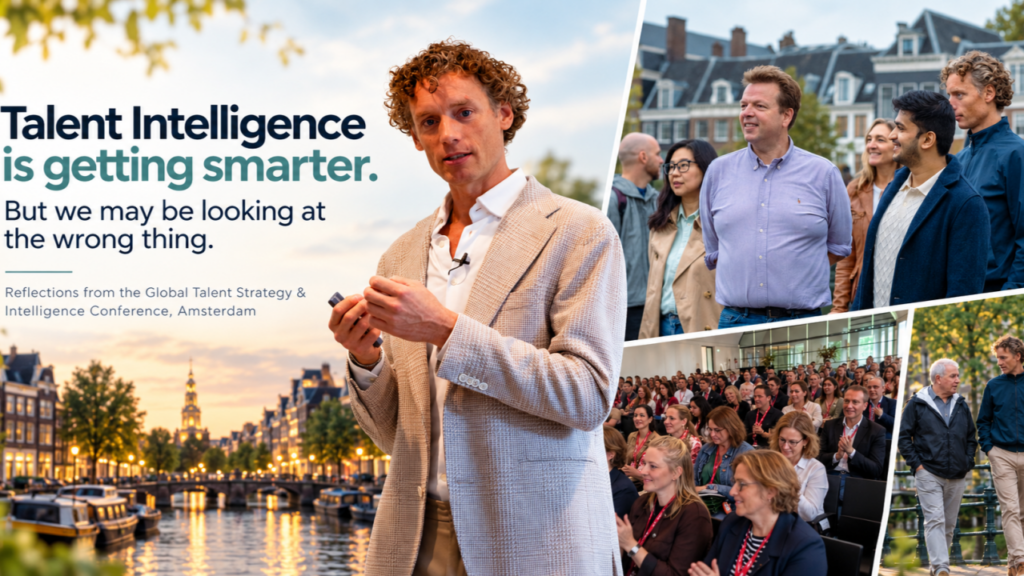
- 29 September | Global Talent Strategy & Intelligence Conference | Amsterdam: From Planning to Matching | Agentic HR
- 6 October | Digitaal Werven | Amersfoort: how AI agents change recruitment and the role of recruiters
- 9 October | GoodHabitz: AI, work and human development
- 20-22 October | Unleash | Paris Skills Based Organizing in the age of AI.
- 3 November | Nationaal Arbo Congres: redesigning work around people, skills and AI
- 17 November | People Analytics & AI: beyond skills, towards continuously understanding people, work and potential
See you somewhere along the way
Laurens Waling
Chief Evangelist, 8vance