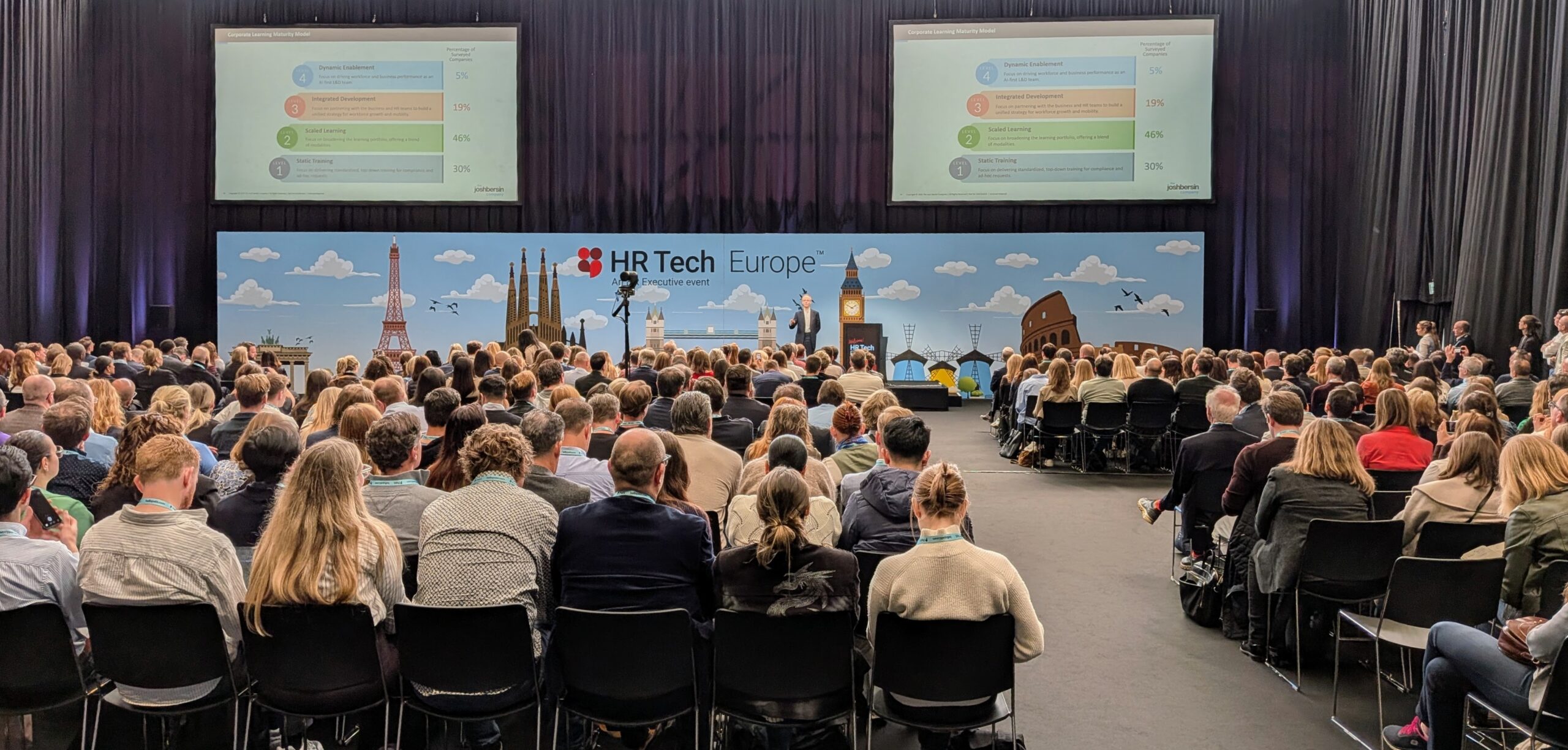
Two days at HR Tech Europe in the RAI in Amsterdam are behind me. What stood out most is how much the tone has shifted compared to last year. Less buzzwords, fewer futuristic promises. More realism. More reflection. And above all: more pressure to prove what actually works.
Where AI was often positioned as the answer to everything last year, the conversations now were much more grounded in reality. Implementation, adoption, and real impact took center stage. The hype isn’t gone, but it has clearly evolved into a phase where organizations are more critical and vendors are expected to deliver tangible results.
AI is maturing, but the real challenge sits beneath it.
Across sessions and conversations, one thing became clear: AI is everywhere. Every organization is experimenting, every vendor has an AI story. But the questions have fundamentally changed.
It’s no longer about what is technically possible. It’s about what is actually running in production, what value it delivers, and how it scales within organizations that are often not yet designed for this way of working.
At the same time, topics like explainability, governance, and compliance have moved from “nice to have” to absolute requirements. Especially in HR, where decisions directly impact people’s careers, transparency is becoming non-negotiable.
The 8vance teamn at our stand

Skills-based working is no longer a vision, but a necessity
Another strong signal: skills-based working has moved beyond inspiration into execution. For years, the conversation was about why this matters. Now it’s about how to actually make it work.
Internal mobility is increasingly seen as a key solution to talent scarcity. Not because it sounds good, but because external hiring alone is no longer sufficient. At the same time, many organizations are still struggling with the fundamentals: making skills visible, ensuring data quality, and integrating this into existing systems.
What’s interesting is that many solutions still sit on top of traditional structures. Jobs and roles remain the foundation, with skills added as a layer on top. That approach works, but it also limits the potential impact.
More context on broader HR tech developments and workforce transformation trends: https://www.reworked.co/events/conference/hr-tech-europe-amsterdam-2026/

HR is shifting toward decision-making, but not quite there yet
A recurring theme in keynotes and panel discussions was the evolving role of HR. Less administrative, less supportive. More focused on steering the organization.
In theory, the direction is clear: HR should not just report what is happening, but actively shape decisions around workforce, deployment, and development. In practice, many organizations are still in transition.
The ambition is there, and the technology is evolving quickly. But the foundation is often missing. Data is fragmented, systems are disconnected, and processes are historically grown rather than intentionally designed. As a result, moving from insight to action remains difficult.
The real problem is not technology, but complexity
Perhaps the most important takeaway: technology is rarely the main issue. Complexity is.
Many organizations have built up a fragmented HR tech landscape over the years. New tools are added to solve problems, but often increase fragmentation instead. AI is then layered on top, while the underlying data and processes are still not aligned.
The result: impressive demos, but limited real-world impact.
A useful perspective on these challenges in HR tech: https://www.uctoday.com/talent-hcm-platforms/your-insiders-guide-to-hr-tech-europe-2026-amsterdam/

What triggered me the most
What stayed with me most is the sense that we are at a real turning point. Not just technologically, but organizationally.
We are still organizing work around jobs, departments, and FTEs. Models that once made sense, but increasingly struggle to keep up with the dynamics of today. At the same time, we are introducing AI solutions that are built on flexibility, granularity, and real-time insights.
That creates tension. But also opportunity.
If you start organizing work around tasks and skills, and use AI to continuously rebalance that work, something fundamentally different starts to emerge. Not just a more efficient version of the old model, but a new model altogether.

What this means going forward
The real value in HR tech is no longer in adding another tool. That phase is behind us.
It’s about systems that truly understand:
what work is: tasks, context, required skills
who people are: potential, preferences, development paths
and how to connect those two dynamically
Not after the fact, but upfront. Not static, but continuous.
That’s where the first real breakthroughs are happening. And that’s where the next wave of impact will come from.
Curious to hear your perspective.
What was the moment where you felt: this is becoming real? Or where did reality still fall short?