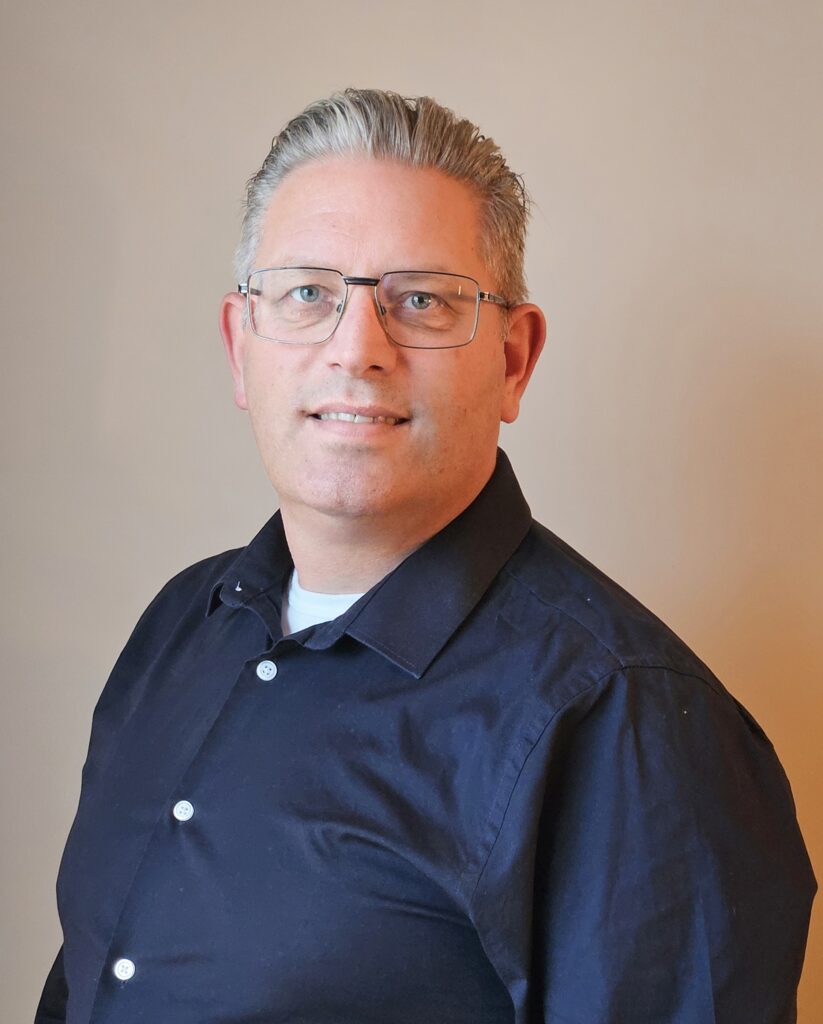
Sometimes something comes along that permanently changes how you look at work and development. For Michel Milder, Supply Chain Engineer at Moba Group, that moment came with the Skills Passport. As one of the frontrunners in the Metal and Electrical sector, he took part in the sector pilot launched jointly by the trade unions, TNO and 8vance. The results were surprising and gave clear direction.
I was curious whether I could enrich myself, Michel explains. Gain more insight into my skills, and see whether there might be broader possibilities than what I am doing now.
An unexpectedly broad range of skills
Michel has worked in supply chain roles for more than twenty years, at Bosch and now at Moba. He mainly saw himself through the lens of projects, processes and optimisation. That changed when he completed the full Skills Passport.
The method, a combination of an in-depth assessment, AI-supported analysis and a sector-wide job landscape, revealed something different.
It was truly an eye-opener for me to see how broadly skilled I am. A much broader set of skills than I had realised myself, says Michel. I only saw that once everything was made visible in one place.
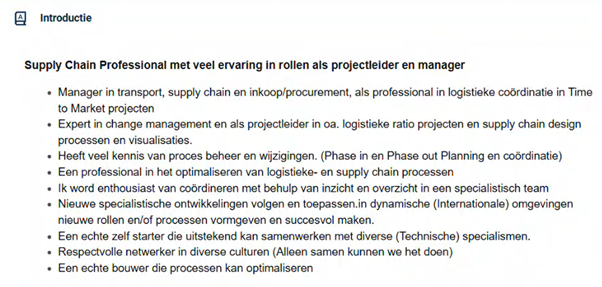
Michel’s profile was translated into skills using the AI of 8vance.
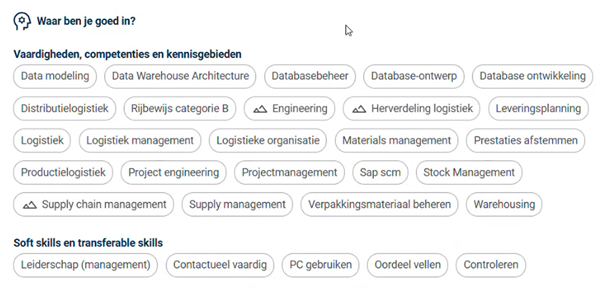
These new insights turned out to be not only interesting, but also immediately applicable.
I did not realise I was deployable so broadly.
New conversations, new paths
Michel has not yet discussed his Skills Passport in detail with HR. He has, however, indicated that he wants to increase his job satisfaction by exploring new challenges within the supply chain department.
I have not yet had a conversation with HR to discuss my Skills Passport and my ambitions. I have aligned that I want to look at new challenges within our department to increase my job satisfaction. In follow-up conversations, I will certainly share my Skills Passport to explore how my skill set can best be used.
For his organisation, this way of looking at talent is still relatively new. Even so, he sees movement. His organisation is investing in an internal development platform and talent development is receiving more attention. Linking this to skills seems logical to him.
It would fit perfectly. You can see which skills someone has and which still need development. You can link that to training. That makes development paths much more attractive.
A sector starting something new
Michel has followed developments in the sector for years. As a trade union member, he closely follows collective labour agreement developments.
Through the union I receive a lot of information about the collective labour agreement negotiations. The Skills Passport has been mentioned for years. The willingness is there. But within companies it is often still unclear what it exactly is and what it can mean.
He expects this can change quickly once both employees and employers learn how such a passport can be used:
- for sustainable employability
- for strategic workforce planning
- for internal mobility
- for making talent visible that would otherwise remain hidden
The Skills Passport is an intervention with significant potential impact.
In this, Michel’s story aligns seamlessly with what we previously announced in our sector update about the Metalektro Skills Passport pilot, a movement that is now becoming increasingly concrete.
AI as a quiet force in the background
AI plays a role in the assessments Michel completed, although the outcomes always require human interpretation.
You see that certain connections are automatically recognised. But you still need to discuss them together. AI helps, but the final outcome always requires human interpretation.
That is exactly the strength of this method: technology that supports, not decides.
Michel as a frontrunner helping others move forward
He describes himself modestly, but Michel is an example of the kind of employee this transition needs: curious, eager to learn, and willing to explore new directions.
Sometimes I run five steps ahead of my environment. That is a challenge, but also a strength. I enjoy diving into new developments.
He has already given a guest lecture, shared feedback with TNO and enjoys contributing to the further development of the method.
If I can help, I am happy to do so. I enjoy doing something extra and making a contribution.
Why the Skills Passport works
The Skills Passport gives Michel, and soon thousands of others, three things:
- Insight into what you can do, also beyond your formal job profile.
- New perspectives on roles, tasks and development paths.
- Language to have meaningful conversations with HR and managers.
Michel’s story shows that skills are not just a concept, but a direct key to career development and agility within the sector.
Let it be approached broadly. That benefits both sides, Michel said at the end of our conversation.
And that is exactly what the Skills Passport does: making opportunities visible. For employees, employers and the Metal and Electrical sector as a whole.